

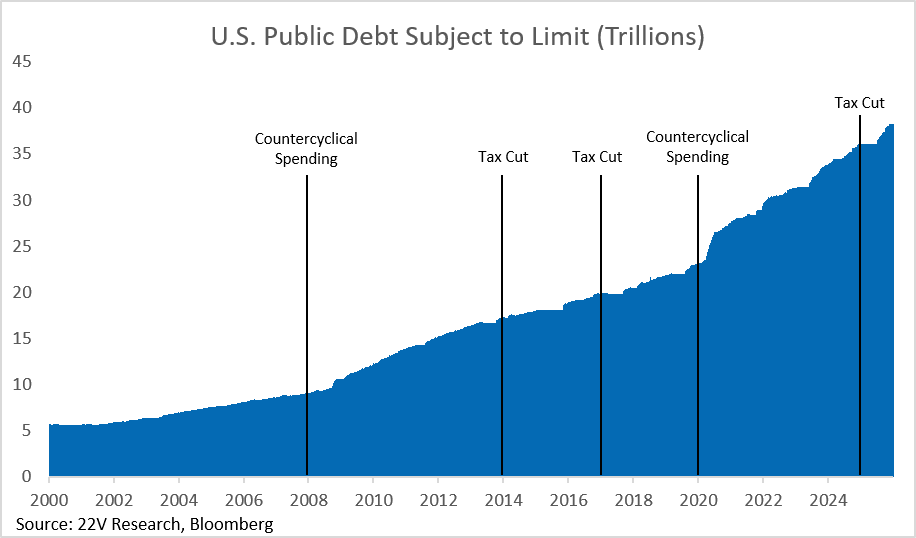
Fiscal policy suffers more than most DC substantive debates as narrow voting margins the past decade or so empower those in the tails of the political spectrum. Approaching $40 trillion (120% of GDP), US debt subject to limit nearly doubled in the period. Unfinanced countercyclical spending and tax cuts are major contributors shown in our accompanying graph. Demography-fueled entitlement spending, policy rates, and the self-feeding base of debts in the absence of remedial policy complete the picture. Washington seems unlikely to significantly worsen or improve the picture this year, but fiscal folly (our term is fiscalamity, coined 15 years ago) seems destined to inflate volatility in markets and on the floors of Congress before the October 1 start of FY27.
Workable estimates delay until about this time next year the more worrisome, routine fiscal drudgery of debt ceiling adjustments. That is good news for now. In this quarter, Washington’s mild fiscal challenge includes a concise list:
- Averting or accepting an Oct 1 shutdown of nonessential government operations.
- Funding defense spending (entire FY27 Pentagon budget or just war FY26 supplemental)
- Deciding by which method to fulfill the second objective.
The following 3Q26 fiscal scenarios attempt to frame risks not predict outcomes. At present neither Congress nor the White House offer guidance or even durable clues about resolving lingering fiscal uncertainties. One can glean from the past two weeks that Congress hopes to avoid shutdown fiscalamity one month out from midterm elections.
Likely Scenario (55-60%)
FY26 defense/nondefense spending supplemental (60-70%) or reconciliation (30-40%) by third full week of September ($50-100b).
- Preclude shutdown through Nov 15/20.
- Oct 1 shutdown odds today feel <20%. Grandstanding on both sides will become headline vol by Sept 17 or so and sentiment risk rises steadily if a deal does not materialize by Sept 25.
Plausible Scenario (25-30%)
Prior to election risk aversion motivating compromise, midterms friction forces the tails of each dominant party to pretend to possess or exert demonstrable leverage for terms favorable to partisan positioning.
- FY27 begins under six-week continuing resolution through Nov 10 to maintain government operations.
- $50b Defense replenishment funds, and a similar amount for emergency disaster relief.
Unlikely Scenario (10-20%)
Electoral risk aversion produces an October 26-November 6 very short-term agreement to reopen the shuttered parts of government.
- Limited Pentagon replenishment funds with no bump to domestic spending.
- Election intrigue fuels fiscal partisanship leading to another shutdown.
Important dates
April-July 2027 – next debt ceiling deadline window
Jan 3 – 120th Congress sworn in (date per the Constitution; the 4th more likely)
Dec 21 – target adjournment of the 119th Congress
Dec 2 – Congress returns from Thanksgiving break
Nov 20 – Congress breaks for Thanksgiving
Nov 10 – Congress begins lame duck session
Nov 3 – Election Day
Oct 6 – Congress recesses for elections (subject to uncertainty)
Oct 1 – FY27 begins
Sept 21-23 – Yom Kippur recess
Sept 14/1 – Senate and House conclude summer break, respectively (subject to uncertainty)
Aug 8/9 – Senate begins summer recess (House left two weeks ago)
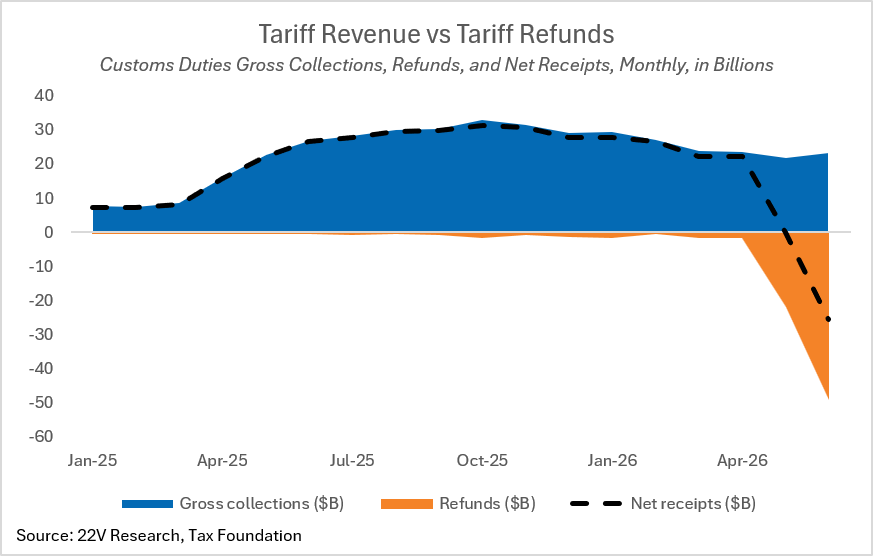
This calendar of potentially important dates and, in italics, those that could affect risk sentiment in the next five months with debt ceiling added for context. My sense remains that appropriations rather than reconciliation legislation is a more likely funding path for defense money this year. The latter requires explicit heavy lifts in the Senate. The following graph shows IEEPA tariff refunds weakening the 2H26 fiscal balance. Higher deficits and inflation headlines will not ease voters’ economic conditions concerns.
The Senate Finance Committee today listened to testimony exploring ways to enhance Social Security solvency. Dr Alan Greenspan more than 40 years ago led the last successful effort to prolong solvency, well before the front end of baby boomers began drawing down benefits. Republicans embraced pursuit of another commission to insulate the effort from predictable zero-sum politics. Democrats favored Congress doing the job, recognizing politics as just one of many difficult elements of approving necessary policy.
22V Research summer intern, Alexis Curisaca meaningfully contributed to the note and conducted useful research of issues including trade, data centers,and cybersecurity. Thanks Alexis and have a great fall semester.

