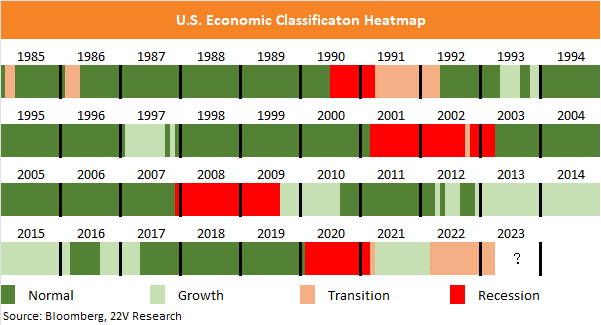
Major macro forces like inflation, unemployment, commodity prices, and consumer confidence continue to paint an unclear market backdrop. Our Macro Regime Classification Model continues to classify the current economic regime as a “Transition” phase. That means the near-term probability of a recession remains low, but broad macro data has not shifted in a way that indicates a sustained reacceleration of growth.
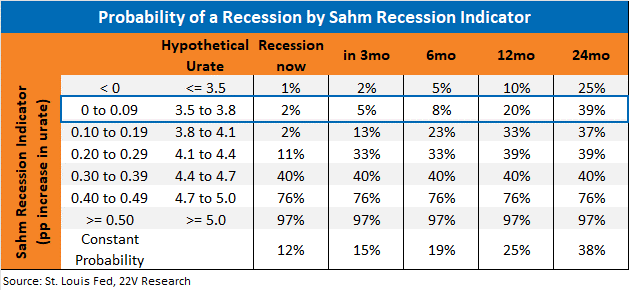
The Sahm Rule recession indicator, which is based solely on unemployment rate readings, currently puts the recession probability at 2% and 8% six months from now. To push the recession odds above 50/50, the unemployment rate would need to increase by more than a full percentage point. This unusual distribution of data highlights the importance of taking a holistic approach when determining the economic regime.
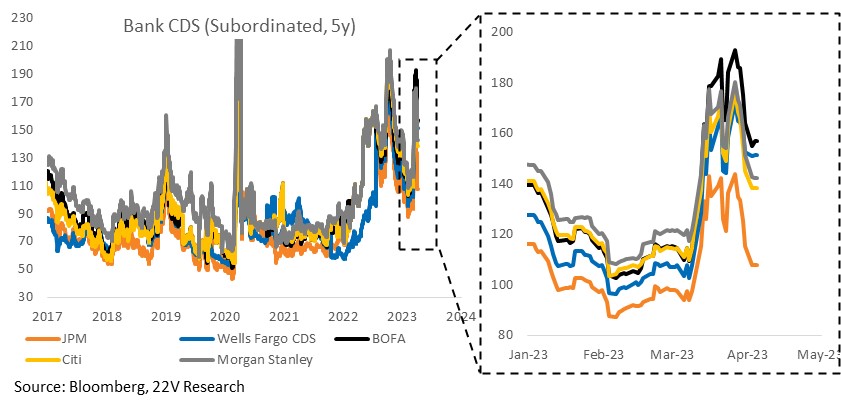
Bank CDS spreads have recently fallen further from their post-SVB/SBNY/CS failure peaks. The narrowing of these spreads and stabilization of borrowing at the Federal Reserve signal that banking stress has eased, though it has not yet returned to pre-failure levels. While banking system risks remain elevated, they have not led to the broad credit market disruption needed to drive the economic regime closer to a recession.

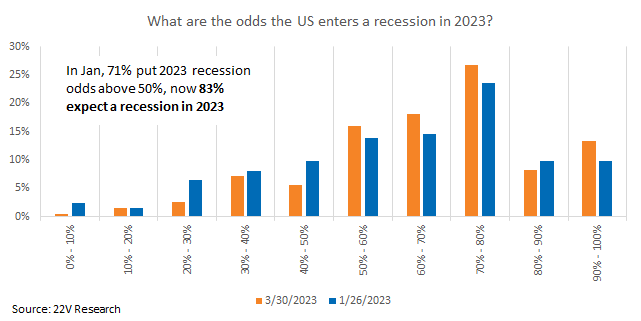
Despite the low recession probabilities indicated by broad data and specific indicators, investor expectations of a recession in 2023 have risen. According to a 22V survey, 83% of investors now expect a recession in 2023, a 12% increase from expectations two months ago.
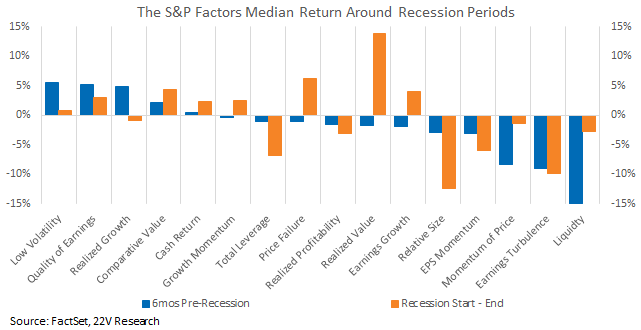
Investors preparing for a recession suggest more mean reverting trends in factors and industries. 6mos before previous Recessions, risk-off factors usually lead (Low Volatility and Quality of Earnings) at the expense of risk-on factors (Turbulence, Liquidity). Indications that growth is remaining firm will encourage risk-on rotations, but broad expectations about recession risk would need to ease before a risk-on trend can take hold. Uncertainty over the path of growth is why we continue to recommend trimming factor exposures, specifically exposure to risk-on/off factors, which are likely to remain very volatile.
Prolonged Transition is Changing the Distribution of Macro Data: Our Macro Regime Classification Model continues to classify today’s backdrop as a “Transition”, but broad data continues to tell a confusing story. Inflation is too high and unemployment too low to call today a Recession. Confidence and commodity prices are too weak to shift the model into a “Normal” growth classification. The distribution of macro data has shifted as well. While classifications for recent months are unchanged and indicate a continued move away from a “Recession” regime, the long period of unusual macro divergences are shifting the broad distribution of data. The bottom line is that based on current macro readings and market indicators input into the model (whitepaper HERE), recession probability stays low.
The Sahm Rule recession indicator, which is based solely on unemployment rate readings, currently puts recession probability at 2%, 6mo out odds at just 8%. Those odds would increase if the urate moves higher, but to get current recession odds above 50/50 would require more than a full point increase in the urate on Friday. This is another example of the odd distribution of data, and why we take a holistic approach to determining the economic regime.
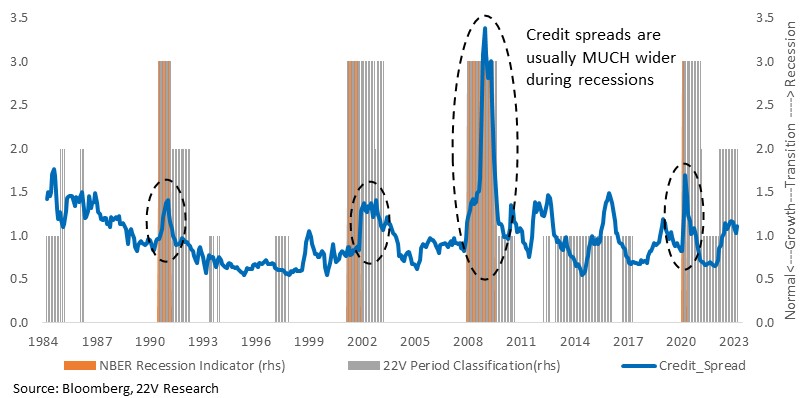
Credit spreads, which usually widen during recessions, have narrowed from their late-’22 peak. Spreads have been volatile, but m/m changes have been stable and at a level lower than typically seen during recession periods. Put simply, credit spreads are typically MUCH wider during recessions.
Yesterday, subordinate Bank CDS Bank CDS spreads fell further from their post-SVB/SBNY/CS failure peaks. Narrowing CDS spreads and the stabilization of borrowing at the Fed indicate banking stress has eased, though it is far from back to pre-failure levels. Banking system risks remain elevated but have not caused the kind of broad credit market disruption needed to drive the economic regime closer to recession.
Recession Expectations ARE Elevated: Broad data and specific indicators do not point to a recession, but investors are increasingly certain one will occur sometime in 2023. 22V’s survey work shows 83% of investors now expect a recession in 2023, a 12pp increase from expectations two months ago. Futures pricing for the peak fed funds rate has also moved lower (peak in June around 5%-5.25%) and is no pricing in cuts in 2H23. Investors are preparing for a recession or at least a significant slowdown in growth that causes a shift in policy toward easing.
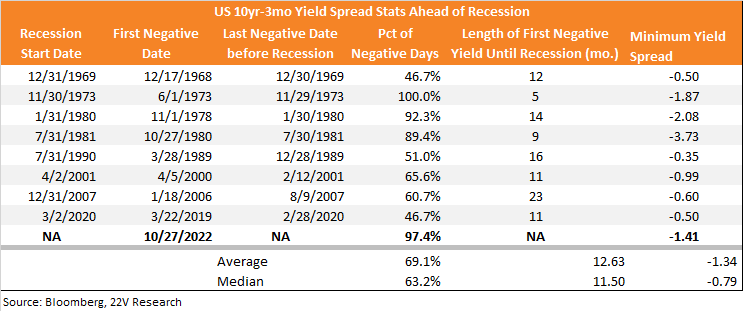
Historically, recessions start ~12 months after the first inversion of 10yr-3mo spread, though there is a wide range (5-23 months). The whole curve inverted at the end of last October, suggesting higher recession risk starting this fall. If broad economic data starts to trend toward levels/changes more consistent with recession periods, our regime model would shift as well. For now, with credit spreads narrow, unemployment unusually low, and inflation still too high, nearby recession risk remains low.
Factors & Sector Trends Around Recessions: Recessions are rare events, so the historical data around them is also limited. With that caveat, 6 months before previous Recessions, risk-off factors usually lead (Low Volatility and Quality of Earnings) at the expense of risk-on factors (Turbulence, Liquidity). Factor returns earlier this year diverged from that pattern with risk-on factors rallying in Jan/Feb. That trend reversed in March (more HERE), muddying the signal from market internals. If a recession cannot be avoided this year, risk-off factors are likely to lead from here. If growth remains firm and a soft landing is achieved, a rotation towards risk-on should be expected. Uncertainty over the path of growth is why we continue to recommend trimming factor exposures, specifically exposure to risk-on/off factors, which are likely to remain very volatile.
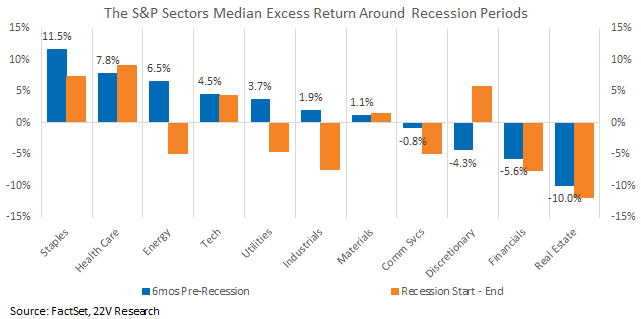
At the sector level, Staples and Health Care normally take the lead 6 months ahead of recessions. REITs and other Defensives typically underperformed. Energy and Technology have also gained ahead of historical recessions. The median excess return 6 months ahead of recession is a mixed result between Cyclicals and Defensives. REITs and Financials are clearly at risk in this backdrop, and we would favor consumer-facing names and Eary Cyclicals more broadly. For a more Defensive rotation to become our base case, broad consumer data would need to deteriorate.