Back Washington Policy

Talk of A Biden/Trump Rematch Isn’t Yet Warranted

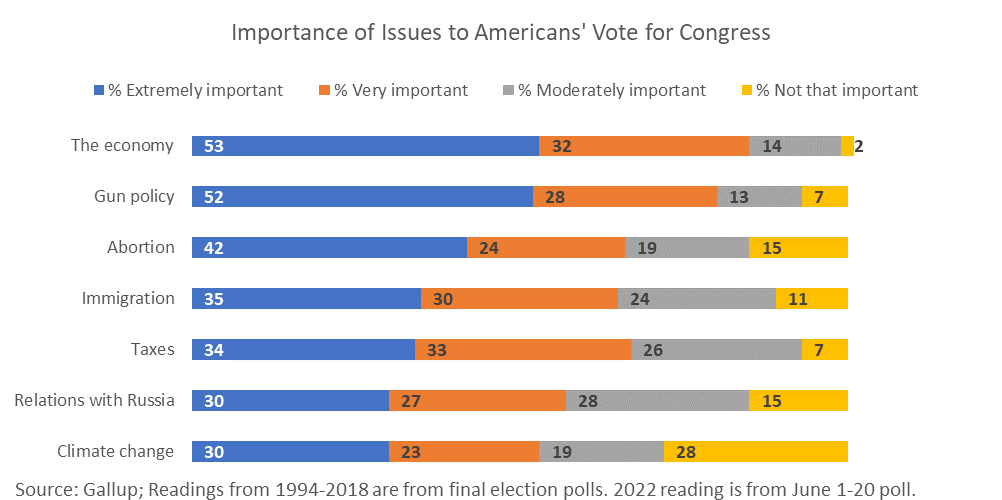
Our monthly elections note picks up where our previous note titled Americans Detest Inflation and Have Strong Views of SCOTUS and January 6 Hearings left off. Specifically, economic issues remain the prevalent topics on voters’ and the larger set of Americans’ minds in recent national polls. Unsurprisingly and unmistakably, cleaner/greener energy transition is a lower priority as many Americans focus on economic pain. The same dynamic developed in 2010 as voters felt on-going agony from a recession the NBER declared was officially over quarters before that midterm vote.
Chart, bar chart

Description automatically generated

No need to gussy-up the obvious fact that the party attracting more Independent votes, especially in Senate races, will have a leg up. The two dominant parties need to appeal to these Independents despite the disdain these unaffiliated voters have for the state of US political affairs.

Table

Description automatically generated

Immigration might be a sleeper issue that neither party is yet positioned to maximize. Here too, the economic angle might be a differentiator. Criminal justice, pathways to citizenship, and access to federal/state benefits are divisive issues in the immigration standoff but the business end of this topic may provide productive opportunities for compromise. For example, a group of mainly farm belt Republicans are pressing their party to rationalize agriculture visas (meaning make more available).
Table

Description automatically generated

With a little less than four months until the 2022 midterm elections, polls reveal a few consistencies and some notable trending changes over the past month. What remains the same since our June elections note and May inaugural 2022 midterms report?

  • Inflation and economic conditions affecting household purses are the top voter issue.
  • Democrats seem very likely to lose both sides of Congress to their opposition, although Senate Republicans are dealing with candidate quality issues in a few Senate races (especially Georgia), and some sharper fallout from January 6th House Committee (especially in Wisconsin) than we foresaw a quarter ago. The Senate was always going to be the tightest outcome; a 0 to 2 net seat change seems to be the range.
  • President Biden’s support among the traditional Democratic base that elected him continues to erode.
  • Elon Musk’s tweets, Senate Minority Leader McConnell’s seemingly increasing anxiety, and Trump-appointed Republicans’ testimonies against his stewardship of office likely create a GOP electorate that is open-minded about who their 2024 nominee will be.

What’s different?

  • As mentioned, a basket of social policy issues is growing in importance to some voters (guns, abortion, and immigration very recently). Economic issues are unlikely to be displaced, given (1) a CPI reading yesterday that was hotter than some of the mass captured by the amazing Webb Telescope, (2) the Fed’s promised response to that well-established trend, and (3) a no longer tightening job market.
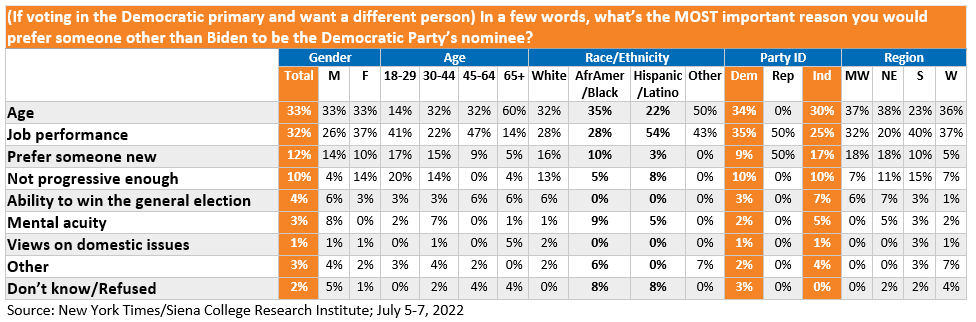
  • The erosion of Biden’s support among Democrats is across the political spectrum. But the table above lists him “not being progressive enough” as the fourth most popular reason respondents’ aren’t enthused about him running for re-election. If it were only Democrats he had to worry about, a naturally moderate campaign plan might work for him. Also worrying, counterintuitively, is that cognitive ability ranks in the bottom half of reasons for Biden’s unpopularity.
A picture containing calendar

Description automatically generated

Where we stand today, it is unclear whether either President Biden or former President Trump will be a viable candidate in 2024.