
We call your attention to four key multilateral meetings this week: G20 finance ministers; NATO defense ministers; EU Council annual conferences with the African Union; and the US Security Council (UNSC) review on the Minsk Accords. Overlapping country memberships in the UNSC, NATO, the EU, and the G20 assure geostrategic and macroeconomic tensions driving headline and tangible risks receive a full, even if not dispositive, airing.
Brussels is about 7,100 miles from Jakarta but this week the two capitals share proximity on matters important to global markets. At the end of the week, G20 finance ministers and central bank governors discuss economic and financial stability as inflation forces a reversal to less easy money. Rounding out the week is an unusual crush of multilateral organization meetings. All reflect the long-standing dominance of the Transatlantic partnership, but the UNSC and G20 get-togethers also show the growing influence of eastern hemisphere leaders.
The G20 Jakarta meeting will displace but not eliminate concerns about macroeconomic policy implications of sanctions against Russia if it invades Ukraine. The 2010 consequences of US sanctions against Iran won’t have receded far from the memories of developing country policymakers. Circumstances differ now but the global ramifications of US decisions are a constant if sometimes uncomfortable topic at multilateral policy conferences. This reality isn’t on the US-focused agenda but won’t be avoided in sessions Friday at the US Monetary Policy Forum hosted by the University of Chicago’s Booth School of Business. Federal Reserve governor and vice chair nominee, Lael Brainard, participates in the concluding panel discussion.
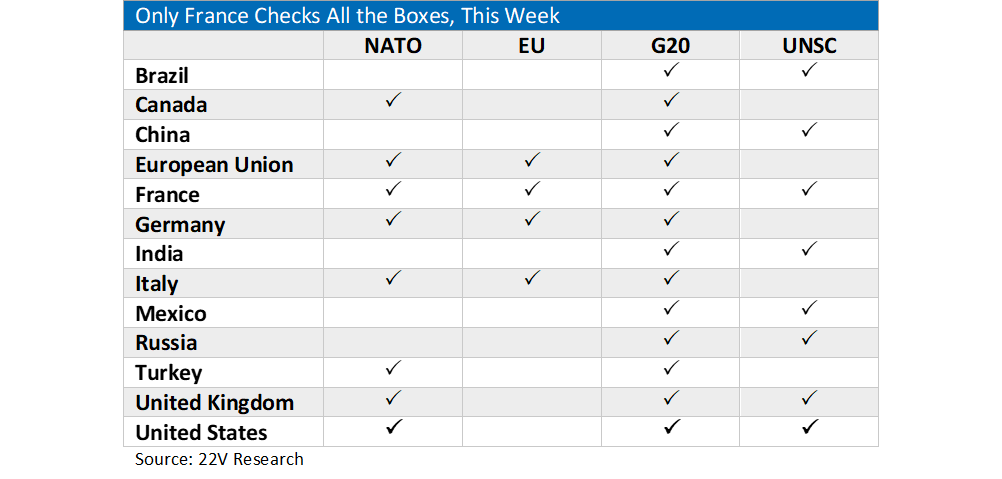
France will be the only country attending all four multilateral meetings this week. President Macron was the last western leader to meet in person with President Putin. Clear if not diametrically opposed versions of their meeting serves Putin’s interest in keeping NATO and others confused about his near-term designs. After meeting today with President Zelensky, German Chancellor Scholz flies to Moscow for a Tuesday audience with Putin. It’s hard to forget Russian Foreign Minister Lavrov’s allusion last week that meetings lately between western heads of state and Putin resemble discussions between two people unable to communicate with each other (his exact words were a bit crasser). Obfuscation or not, his construct was not intended to rebuild hopes for de-escalation of tensions.
NATO defense ministers are set for conversations over two days in Brussels beginning Wednesday a few days before the annual Munich Security Conference kicks off on Friday. The EU Council on Thursday begins its sixth annual conference with the African Union. The full list of important matters on the agenda won’t be enough to preclude the focus on Ukraine/Russia. France holds the Council presidency through June this year; Macron and Scholz will have the freshest input from Putin which gives the Russian yet another western heads of state gathering to inhabit.
Russia holds the UNSC presidency this month and will hold the gavel at the scheduled February 17 status review of the Minsk Accords (aka Agreements, Protocols). The 2014/15 pacts were put in place to create a path toward resolution of disagreements between Russia and Ukraine over an aspirational list of sovereignty, economic, and security arrangements. Neither Moscow nor Kyiv see the Protocols as actionable. More than signaling a closing of rifts, this session evinces the ability of Eastern capitals (Beijing, Moscow) to sideline the UN as an effective venue for calming nerves.
Outlook
Geostrategic and economic policymaking bodies remain dominated by western and northern hemisphere countries, especially the UNSC, NATO, and the G20. Their membership is diverse and doesn’t imply, much less guarantee, unity on crucial matters – a fact that will be prominent this week as Ukraine and central bank policy cycles dominate headlines. We think the current chairman of the Munich Security Conference, Wolfgang Ischinger, frames geostrategic risks well: “Our world is in danger. Traditional certainties are crumbling, threats and vulnerabilities are multiplying, and the rules-based order is increasingly under attack. The need for dialogue has never been greater.”

