
Two predominant, related lessons from the Virginia gubernatorial race should resonate with parties controlling national and state legislatures. First, the political hymn book instructs that delivering on promises is paramount if parties in power expect their constituents to remain supportive. The other is that in the absence of a compelling narrative of high-priority achievements, challengers can win by defining you.
Governor-elect Glenn Youngkin (R-VA) took advantage of proximity to national Democrats engaged in a three-months internal debate over and economic and social agenda bereft of accomplishments that animated their base in 2018 and 2020. Youngkin ran an effective campaign that spoke to Virginia Republicans’ and Independents’ concerns about public school curriculum while neither Terry McAuliffe nor national Democrats could demonstrate delivery on promises that got them elected last year.
We have always placed more credence in polling trends rather than individual polling surveys of any organization. Nonetheless, over the decades we have developed affinity for the work (subject matter curiosity), longitudinal databases and accuracy of the Pew Research Center and the NBC/Wall Street Journal (now NBC News Survey) polls. What becomes clearer is that “all politics is national.” Don’t trust us, read through the academic paper of the same title from a couple of Emory university professors.
Back to Virginia. While there were dozens of interesting mayoral and still-undecided New Jersey governor’s race, Virginia absorbed plenty of national press as a proxy on Biden and the 2022 midterms. Time will tell how linked this race and the next national elections are, but that narrative dominates for now. As a minimum, it will provide a test of 2022 voter turnout strategy.
In its February edition, Inside Elections analysts observed that Youngkin was one of three GOP primary candidates that would try to use school closures as a wedge issue to win back the suburban voters that have fled the Virginia GOP in recent years. Youngkin won the primary and the general election by sticking to a cultural message that neither required him to explain much else of his agenda. McAuliffe relied on Democratic luminaries, a campaign against an unpopular former president, and an aspirational national legislative program to magnify his agenda. Lessons possibly learned.
A narrow congressional majority enthralled in debates of a transformative legislative platform in essence ran out the 2021 electoral clock, leaving McAuliffe with himself which apparently was not enough. A right middle- and rear-guard action against which he had little resistance was amplified by an unpopular sitting president whose standing was/is defined by a pandemic and global supply chain over which he has little control perceptively or practically. As that metric drifted negative this summer, so did McAuliffe’s six- or seven-point lead. Few surveys captured Biden’s rupture as well as the September 24 Pew poll: Biden Loses Ground with the Public on Issues, Personal Traits and Job Approval.
The poll is a devastating (certainly in the moment) presentation of how the very factions that elected the president are abandoning him. Nationally, he lost eleven points on his job approval rating – in two months. Among Blacks, he lost 18 points. Voters aged 18-29 gave him a 42% favorable rating – 12 points lower than in July. Twelve percentage points fewer women approved of his job performance. If the Virginia matchup reflects national sentiment, it is shocking McAuliffe polled as well as he did during the summer.
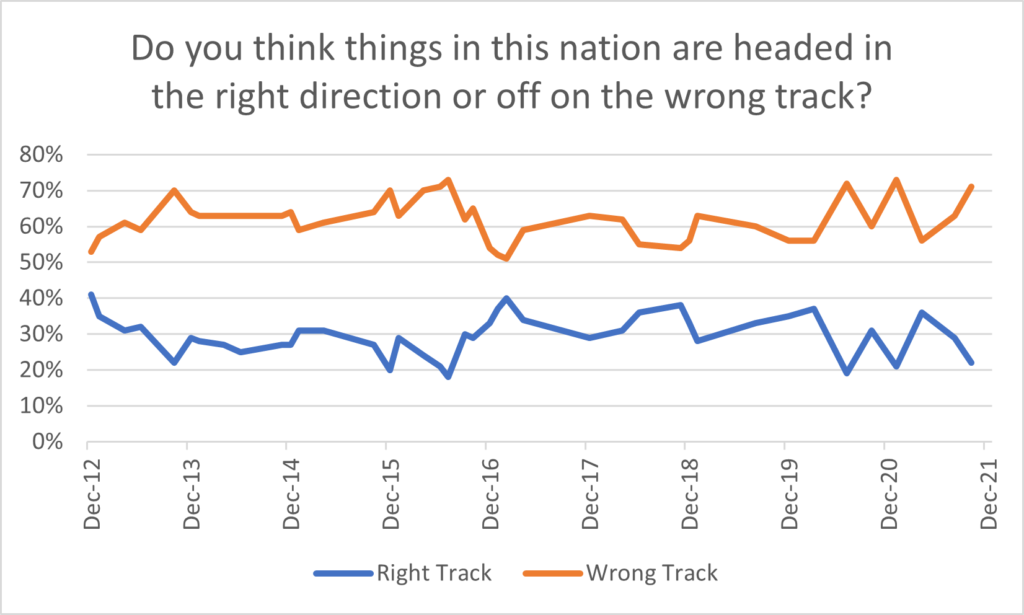
The most recent NBC News Survey offers little solace for the Democrat when viewed through the national lens on Biden. There are many ways the polling question is asked but whether the country is on the right or wrong track foreshadowed majority party House losses in Trump’s and Obama’s first midterms. Each of those presidents carried a negative 16 net wrong track reading in late October a year out. Biden’s right/wrong track net currently stands at negative 49.
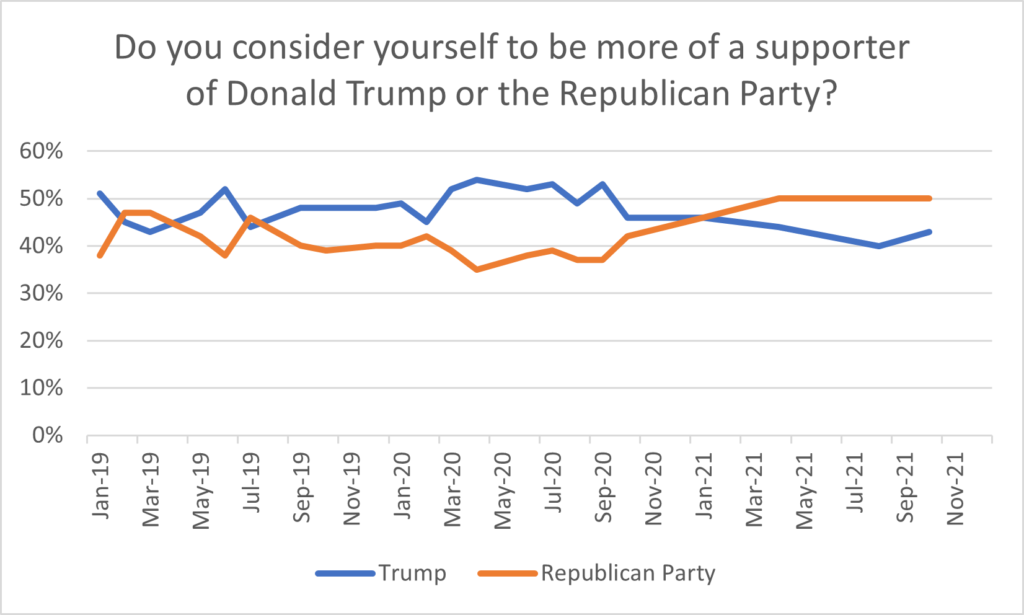
Back to Virginia. In the same survey, Democrats retained a ten-point advantage over Republicans on the issue of education, but absent fresh evidence of focus on the subject could blunt Youngkin’s advantage. The extent to which former President Trump holds sway over GOP voters was also tested given Youngkin’s closeness but not coziness with some Trump messaging. The current NBC poll goes back to January 2019 asking self-identified Republicans whether they support the party or Trump. Trump’s apex was in April 2020 when he had a net 19-point advantage over the GOP. Now GOP partisans tell NBC pollsters they support the party by a net seven points. Trump’s reclaim of the mantle ticked up just as Biden’s hold over Democrats dipped.
We cast wary eyes on prediction polls in which participants openly indicate their personal preference rather than a studied point of view. A useful reminder comes from the site FiveThirtyEight. On October 22 of this year, it updated a series that tallied how often members of Congress voted with President Biden.
Senators Joe Manchin and Kyrsten Sinema this year have voted 100% with Biden. These votes occurred on easy and contentious nominations, as well as no-brainers such as providing more Capitol Hill security, and tougher votes like voting rights (Stacy Abrams endorsed Manchin’s bill). On seven close votes, the site’s algorithm predicted less than a one percent probability – often one-tenth of a percent – that Manchin would side with Biden. Statistics and manipulation of them are wonderful, but as they say in sports – that’s why they play the game.
As we wrote in an October 21 report, the Virginia outcome which will positively affect the winning party in the midterms, especially if the incumbent Democrat loses in New Jersey. For Democrats and their voters, President Biden’s fiscal agenda and his second-year policy pursuits which we highlighted last week, might produce tailwinds going into the midterm elections. Ironically, hours before the polls closed on the east coast yesterday, Congressional Democrats announced a deal to reduce prescription drug prices. We’ll write on those details once released, but McAuliffe and Phil Murphy surely wish that headline had come a few weeks or months sooner.

