
The current and most recent former presidents are not on the ballot in Virginia’s gubernatorial elections one week from today, but neither candidate can get away from President Biden or former President Trump. The Republican candidate, Glenn Youngkin has run an effective race focusing on parents’ fears of how schools should instruct their children. Terry McAuliffe, a former governor of the state, early on and lately highlighted his opponent’s ties to Trump. As we have previously written, the race is a bellwether for policy this quarter and the political prospects for each party heading into the 2022 midterms.
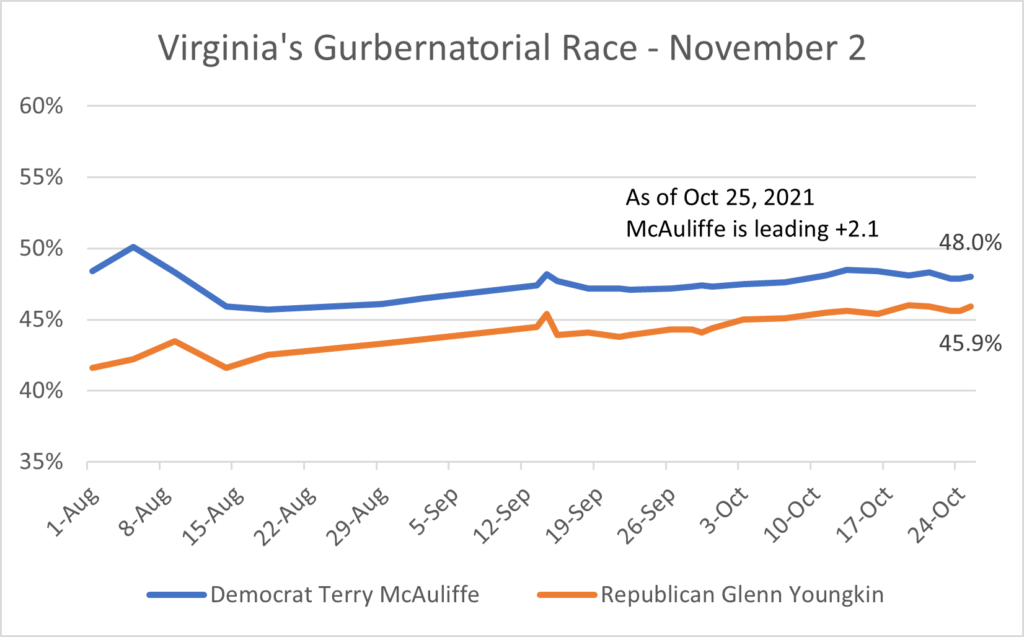
Youngkin, from bluer northern Virginia and a former capital markets executive, has stressed national Democrat’s inability to move their agenda in nearby Washington, D.C. Concerned about turnout, high-profile nationally recognized Democrats have recently campaigned with McAuliffe; former President Obama recently was in-state just after Stacey Abrams toured Virginia regions known to support Democrats, especially in the past six years. What had been a 6- to7-point race favoring McAuliffe during the summer has closed to within the margin of error in most polls, but still favoring McAuliffe.
In early October, a CBS/YouGov poll validated both candidates’ messages. Among registered voters who had not voted yet, 2020 Trump voters were twelve points more likely than Biden voters to say they will definitely vote this year (88% vs. 76%). Obama’s message to Democrats was despite four years of consequential elections, “y’all can’t afford to be tired.” The survey showed strong support for Biden’s stimulus program, both how it would be funded (taxing high earners (67%) and corporations (68%)), and the programs identified (2-year free college education, child and elder care, broadening healthcare access and affordability, and family and medical leave). Forty-one percent overall thought the legislation would help the economy and 45% thought it would help “future generations”.
Consistent with national polling, respondents from Virginia were most worried that the Biden administration was focusing too little on inflation (60%), the US-Mexico border (57%), and the economy and jobs (53%). Nonetheless, 54% approve of what they know about the infrastructure bill and 53% favor the “Build Back Better” proposal. Tellingly, when asked about with whom they agreed among the political factions negotiating, the largest plurality (36%) said they had not heard enough about it. The second most popular answer was “Republicans” (26%). Given the GOP has not been party to the talks, the last point cannot boost Democrats’ spirits. Biden received 57% approval for his coronavirus vaccination efforts but only 45% for his handling of the economy.
Democrats’ circling of a final fiscal deal is in the party’s broad interest, especially President Biden’s. Overall, survey respondents do not think the president is effective in the job (55% vs. 45%). The combination of not knowing what is in the Biden’s signature legislation even though its major components are popular, economic concerns in a generally hot economy, and questions of the president’s efficacy in office point to possible upsides if reconciliation and infrastructure are passed. Sealing a deal this week could help Biden and McAuliffe. The thesis will be tested as the two are scheduled to campaign together before the president heads to Ireland late this week.

